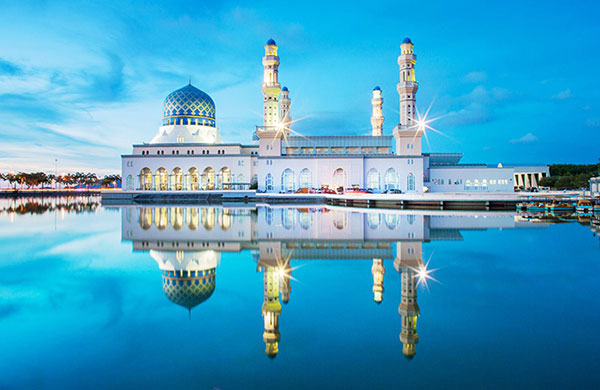

Malaysia
Malaysia is a country in Southeast Asia. The federal constitutional monarchy consists of 13 states and three federal territories, separated by the South China Sea into two regions: Peninsular Malaysia and Borneo's East Malaysia. Peninsular Malaysia shares a land and maritime border with Thailand and maritime borders with Singapore, Vietnam, and Indonesia. East Malaysia shares land and maritime borders with Brunei and Indonesia, as well as a maritime border with the Philippines and Vietnam. With a population of over 34 million, the country is the world's 43rd-most populous country. Malaysia is tropical and is one of 17 megadiverse countries, it is home to numerous endemic species.
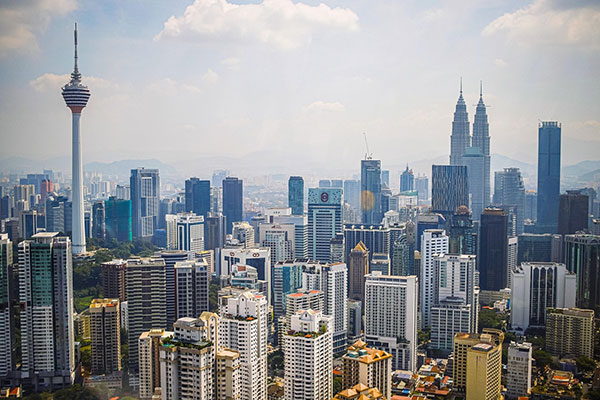
Petronas Towers
The Petronas Towers, also known as the Petronas Twin Towers and colloquially the KLCC Twin Towers, are an interlinked pair of 88-story supertall skyscrapers in Kuala Lumpur, Malaysia, standing at 451.9 metres (1,483 feet). From 1998 to 2004, they were officially designated as the tallest buildings in the world until they were surpassed by the completion of Taipei 101. The Petronas Towers are the world's tallest twin skyscrapers and remained the tallest buildings in Malaysia until 2019, when they were surpassed by The Exchange 106. The Petronas Towers are a major landmark of Kuala Lumpur, along with the nearby Kuala Lumpur Tower and Merdeka 118, and are visible in many places across the city.
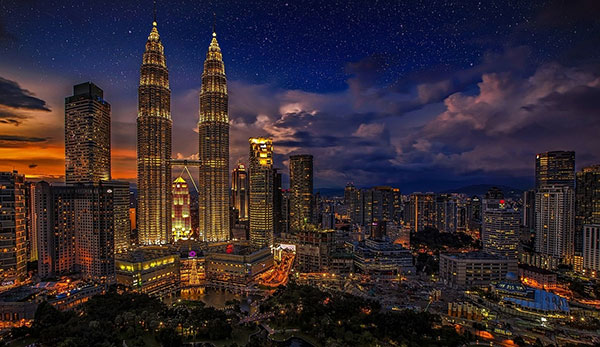
Malacca
Malacca is a state in Malaysia located in the southern region of the Malay Peninsula, facing the Strait of Malacca. The state is bordered by Negeri Sembilan to the north and west and Johor to the south. The exclave of Tanjung Tuan also borders Negeri Sembilan to the north. Its capital is Malacca City, which has been listed as a UNESCO World Heritage Site since July 7, 2008. Malacca is noted for its unique history and it is one of the major tourist destinations in Malaysia.
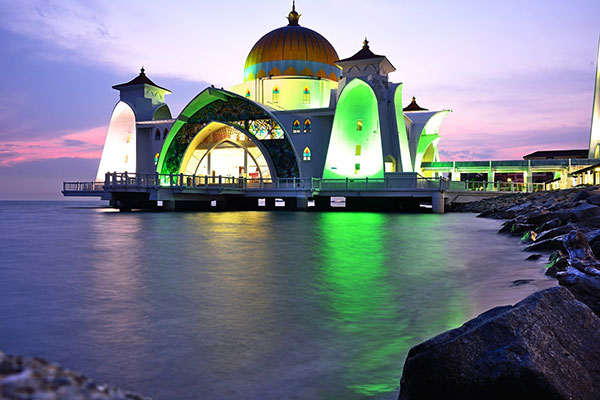
Kota Kinabalu City Mosque
The Kota Kinabalu City Mosque is the second main mosque for the city of Kota Kinabalu in Likas, Kota Kinabalu, Sabah, Malaysia, after the State Mosque in Sembulan. Construction of the mosque cost 34 million Malaysian ringgits. The architectural design is based on the Nabawi Mosque, the second holiest site in Islam, in Medina, Saudi Arabia. The dome is blue and gold, inspired by similar Arabic architecture. It is partially surrounded by a human-made lagoon; this has given rise to the nickname "The Floating Mosque". It has a maximum capacity of 12,000 worshipers.